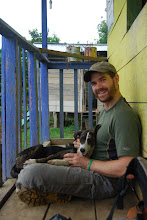
Why:

Dreams are powerful tools that can help guide anyone to success and happiness. They represent some cherished aspiration, an ultimate ideal of achievement.

The word sylvan refers most directly to a setting associated with the woods. Reflecting on the vigorous life that abounds in sylvan settings is a very powerful force in my life. For me, this word evokes feelings of transcendence, clarity, and unity.

A Sylvan Dream is a dynamic compilation of my life dream. It is an attempt to seek out and document the truth, beauty, and clarity that exists in this world.

Monday, February 11, 2008

Relics of Importance

Since leaving high school and my home in York, Pa, I have gradually amassed a shrine of sorts that travels everywhere with me. It consists of items from people and places that hold very important places in my heart, and will forever. Since my freshmen year of college it has grown considerably, but I am still able to look at each piece of it, and remember exactly where or who it is from, and why it is special.


First there is a toucan. This is a rubber toucan that I have had longer than almost anything in my current possession. Its toes have almost all fallen off, so it must lean against something to stand upright. Silas gave this figure to me after a family vacation to Florida or one of the Carolinas.
He has always known how to pick out small gifts that surprise me and show me how much he thinks of me. I remember one time he came to visit my house and saw the toucan on the floor, (since even then it was bad at standing upright, it fell often) and I felt I really let him down when he appeared to be hurt that it was laying on the floor. Since then, I have always felt bad if I see it laying on its side.

There is also a ubiquitous Buddha figure, which for a long time meant nothing to me aside from the memory of a trip I took to Williamsburg, Va, with Silas. We were wandering around a flea market, and I bought this small wooden statue of this Buddha just because it looked attractive to me. I had no clue what Buddhism was, or that it would come to be a majorly transformative force in my life some years later.
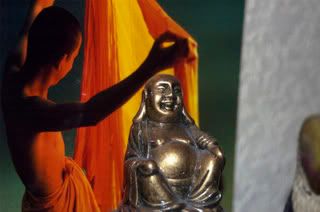
Behind the Buddha is a card of a monk that Sara gave me last year for my Bday. In dark times it pushes me into the next day.

The Buddha is sitting upon two river stones I took from Little Pine Creek, one of the places where I began to realize my serious love for the outdoors, my friends, and simple fun. My father first took me to the banks of where I found these stones, and taught me how to fly-fish. I caught one fish in three days. It was a beautiful rainbow. I had no clue what I was doing then. I didn't even know where my fly was when I felt the fish tug. A few years later, Silas and I went fishing there, and we decided to jump in the freezing creek since we hadn't showered in a few days. We screamed and flailed about, and after the stinging subsided, we swam in the crystal clear current, chased trout, and were free. While we warmed up in the sun on the bank, we began skipping stones. This river bank is still the best place I know for skipping stones. One of the funniest memories of my life is our attempts to skip these stones using our non-dominant arms. The awkwardness with which we failed to skip these rocks had us rolling around on the banks.
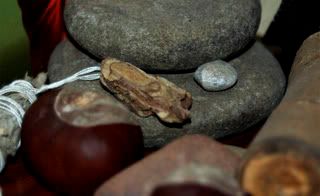
The small white stone upon the river stones is what I believe is an agate, or an oolid. This stone was sent to me from the shores of Lake Michigan by a dear friend whom I met in Washington, Sarah W. If I remember correctly, these are fossils of small, spherical organisms that became clumped together and fossilized. These stones get rolled around in the surf, becoming polished pebbles of visible fossils.
The piece of bark setting next to this small pebble is very special to me. This bark comes from the remaining cedars of Lebanon. Joelle, a very important friend from Germany sent it to me during one of her visits to her father in Lebanon. The Cedars of Ledanon are some of the oldest, tallest and most ancient and sacred trees in the world. The cedar forests of Lebanon are fabled in the bible, but are long gone due to the same human hunger that scars the Amazon Basin, and the slopes of the Pacific Northwest. This bark is from one of the few remaining sages.

In front of the piece of bark lay two buckeye chestnuts. Late one college night I was walking with some dear friends, Pat and Sarah, along one of the circuits of beautiful lewisburg that had slowly become very familiar to us. We intuitively followed each other aimlessly from street to street, to our favorite victorian houses, spots on the river, and our favorite trees. Each fall we kicked the buckeyes up the road and crunched them beneath our feet. I tasted their bitter tannins, and we talked about how they probably got their names from early taxidermy practices. We held the large chestnuts up to our eyes, imagining them painted like an eyeball and plugged into a trophy buck hanging on someone's living room wall. I kept a few in my pocket one night, so I could cling to those chilly nights when all was perfect.

Next to the Chestnuts is a plug of aspen branch, which I intended to carve into a keychain, but later found it fit perfectly on the shrine. I picked this up when Sara and I first truly met each other. I was visiting Co and the mountains for the first time, and we went on a short hike. This is where I found Sara, and saw the person I felt was hiding beneath the surface all the years we sang together at Bucknell.

Next, there is a white piece of driftwood setting atop a darker piece of driftbark. Both came from the Quilcene Bay, during the first summer I lived in Washington. I would ride my bike down Linger Longer Rd. each day after work, and plunge into the salty water, swim with a lone seal, or catch crabs, and some days I would sift through the driftwood, amazed at the designs nature could make with water, wood, and stone. These pieces will stay with me forever I hope. The dark piece of bark came from when I finally returned to Quilcene after being away for several years.

Then there is a sage smudge made by Sara. After I visited her that first summer in Co, and remarked over my love for Sage, she later sent me this after we had finally began dating. It hung in my car for awhile, and now travels from place to place with me. Relics from the beginning of Love are so latent with nostalgia.

Behind the sage smudge is a picture of Peter, during his time in The Gambia, Africa. My time spent with Peter was so short-lived, yet his friendship was/is so uniquely touching and important in my life. I look forward with hope that we will live together again some day.
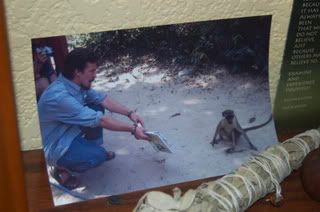
I wonder what will be next. There are a few places and friends who are not represented in this shrine, and while you are very important to me, it gives me hope that there are memories to come in places we have yet to be to add to this shrine.

Sunday, February 10, 2008

Early Life-Part Three, Finding Nature

After Summer ended and second grade brought me back indoors, I was lucky to see another praying mantis egg. In a small patch of woods behind my house, I was waging a war that had been going on for several years now. Within the edge of the woods was a densely overgrown thicket of jaggers, which I much later learned were more commonly called briars. However, between two twelve-foot tall patches of jaggers there was a small passage through which I could enter into a small forest of sumac, and this is where I went wild. What started as a mere interest in helping my dad control our yard by knocking the tops of dandelions with small sticks, as though I was beheading someone, quickly grew into a full blown obsession for running through fields with a specially picked stick. A swath of shredded weeds would lay behind me, and I felt victorious as though I had just waded through a sea of warriors, having laid waste to them all.

I don’t recall ever being given a reason to hide this activity from my parents, but I can’t ever remember them being present when I would unleash such a jubilant rage. There was always a sense of secrecy to these slaughters, and this is exactly what I found in the sumac, well-hidden between the towering jagger bushes.
From the time I was allowed to walk the forests behind my house as early as three years old, I remember the worrying that came with the word poison ivy. There was some bad plant in the woods that could really hurt me, and I had to be very wary of it. At some point, I also learned of something called poison sumac, and I was convinced that my secret forest of sumac was just this enemy.
I went through many of the best sticks while destroying this sumac forest. These were not mere weeds in a field; these towering spindles of sumac blurred the definition between shrub and tree. Some of the stalks were almost the size of my arms, yet I was determined to leave nothing. Soon, I found an unused broomstick in our garage, and felt I had found the best stick of them all. No matter how hard I slashed through the sumac, the broomstick would not give. This is how it went for many seasons, and when the entire sumac forest had been raised to the ground, I would turn to the encroaching jaggers and smoothly shear off all the brighter green new growth protruding from the bushes. My fort was complete. Here I was alone and unknown within a natural fortress. I even began to burrow tunnels beneath the jagger bushes, where I could lay when the sun had made my fortress too hot. I would watch black specks fly past overhead, and remain motionless when sparrows, catbirds, and mockingbirds would creep through the bush, seeking insects.
On a warm Saturday after helping my dad with yard work, I retired to my fort, and resumed the carnage. My broomstick was stained a deep green from months of use. I was leaning against it for a rest, when I noticed a brown piece of Styrofoam wrapped around a jagger shoot I had just separated from the bush. I picked it up slowly, realizing what I had just found. I squeezed it gently, and it indeed felt like Styrofoam, but with a hard core.
Monday morning, my teacher humored my interests, and allowed me to bring the egg into class for all to see, as well as to give it a shelter for when the time came to hatch. Every day, I came into class, inspecting the egg and the glass cage for some change, but there was none. My hope for the egg’s hatching became a distant thought, the way one dreams of what they may get for Christmas when it is still months away.
One morning, while all the students were waiting in the gymnasium for the day to start, my teacher entered the cloud of students and motioned for me, smiling.
“Come, I have to show you something,” she said quietly with controlled excitement.
I felt a little sickness tighten in my stomach. It was all to common for me to be pulled away from the students for a scolding, or to be sent to the principal’s office for something I had done the previous day. Whether it was perpetrating what I thought was a playful fight on the playground, or riding my bike to school as a seven year old, the school always seemed to have problems with my actions. However, through some stroke of luck, this was not the case this morning. We rounded the corner to the glass cage and it seemed to be crawling with a small green mold, as though overnight mold had infested the cage.
“I was just bout to throw it away this morning, when I looked in and saw everything moving. They Hatched!” Mrs. Ritts exclaimed to me.
I couldn’t believe it. It wasn’t a mold at all; rather hundreds of praying mantis babies no bigger than my pinky nail covered every surface of the cage. Life had existed within that egg the whole time! After the class had a day or two to inspect the offspring, we set them all loose in a field outside the school, and I took a handful home to foster on my own.
A month later, three of them remained alive, now about half the size of my thumb. I had spent hours watching them slink around the large canning jar, climbing sticks, falling from the sides of the glass, and periodically batting at each other when they came face to face. I wasn’t sure what they needed to eat anymore, for all the ants I had placed in the jar with them had died strewn about the dirt uneaten. So, I released them into my father’s iris bushes outside, and turned my interests to starting my own any colony from the many ants that frequented our flowerbeds. A week later as I perused the beautiful indigo blossoms where I had released the juvenile mantises, I found one, apparently healthy, and much larger already. If you have never seen a praying mantis turn its head and stare straight at you through its pearly green compound eyes, it is an eerily familiar sight, and I find it hard not to impart some sense of intelligence upon that stare.

Wednesday, February 6, 2008

Early Life-Part Two, Special Things Hide Outside

My fondness of reading didn’t last very long. Not long after I began to read, my family began watching much more TV together. I remember for a long time the TV was always turned off when it was time to eat together. We sat around the table, and talked, and enjoyed our meal. However, shortly after first grade, while it had usually only been a treat to be allowed to eat out dinner while laying on the floor of our living room, it became increasingly common for my parents to take their dinner to the couches, and for us kids to lay on the floor and watch shows like the Simpsons and McGuiver while eating dinner.

After finishing dinner, I would lay my plate in the sink, and sleek onto my mothers lap. Later, after I was too large for her lap, I would squeeze onto the very edge of the chair. This persisted well through elementary school, and completely replaced the ephemeral time I spent reading to my parents. Now the amount of contact I experienced with my parents was not dependent on my reading skills, and my skepticism of reading grew. Books seemed useless to me unless they were explaining some picture in the book of a frog laying eggs, or explaining how the planets of the solar system orbit the sun.

Slowly, science books became the only books I would read in school. It seemed the books for every other topic in school were a waste of time. The teachers seemed to always be giving us all the correct answers we needed to get good grades, and all we had to do was listen to them. But in these books, I found wonders the teachers never talked about. I found things I later learned they barely understood themselves. This is what brought me to the woods.


I was always exploring as a child. Much later in life, while in high school and a few times during college when I remarked to my mom about TV shows all of my friends were familiar with and I was not, or voiced concern, (I guess sometimes pride as well) over how other kids couldn’t climb a tree or catch a frog like I could my mom stated with motherly resolution, “Beej, that’s cause you were always outside. You never wanted to do anything else, you just wanted to be outside.”

Well, I guess it was always clear to me that I wanted to be outside, but I hadn’t entertained the possibility that this wasn’t the case for each and every kid I knew. I still have a tough time finding that other people don’t feel the same about this. Anyways, this was about the time when I found out teachers in a class room would teach you about things they had never witnessed on their own.

The summer before second grade, I was helping my grandmother trim some bushes outside of her house in Chambersburg. The summers were hot, so we got up and worked in the morning, and then sipped sweating glasses of sugary sun-made iced tea in the afternoon. One day my grand mother paused and yelled as she bent closer to a bush she was shearing.
“Oh Beej, come here quick, come look at this,” she exclaimed in the same ascending high pitched voice my mom used when she got excited about something.
I dropped the juniper branches I was carrying that smelled of cat piss, and ran over. I peered into a dark hole where no branches were growing upon this dense evergreen tree, and looking up at me was a pale green insect, nothing like I had ever seen.
This was no beetle, no fly, and no ant I later learned how to burn with a magnifying glass my grand mother gave me for Christmas.
“This is a praying mantis,” she said softly, slowing down and speaking very clearly as she said its name, “they are very special because they eat all the bad flies in these bushes. See how it looks like its prayin,” she questioned, folding her hands like she was praying too, “I just think they’re the dearest things.”

I am not sure I had any idea what bad flies did in bushes, but the fact that my grand mother introduced such a thing to me with such softness and clarity marked this insect to me as forever special. To this day I still feel worse about accidentally stepping on one large female I was trying to catch than I do about anything else I have ever killed. I suppose that was one of the first times I learned that very special things hid outside, and they could be found everywhere.

It was also this summer that I learned what a praying mantis egg was. Again, in similar circumstances, my grandmother called me over with excitement to a large shrub she had been shearing, and she pointed to a small brown piece of Styrofoam about the size of a ping-pong ball.
“When it is time for this to hatch, it will open up and hundreds of little babies will come out,” my grandmother whispered to me with quieted importance.
I had trouble picturing hundreds of babies, miniature versions of what I had seen just a few days before, emerging from such a small thing.

Friday, January 25, 2008

Early Life - Part 1, Learning to Read

Learning to Read
1/25/08
---
While I was home during Christmas, it was great to spend so much time with my family. Although home is mostly the same when I go home, I witnessed subtle changes, one of which returned me to my childhood momentarily.

I was leaving to meet up with my friends, and my mom was sitting at the computer with my niece on her lap. Mackenzie was pounding on the keys, and my mom was urging her not to be so hard on them.

“What’s that,” Mackenzie would demand with a smile as she pushed her finger to the computer screen. My mom would try to sound out a word if there was a semblance of one, sometimes she would tell her to keep typing.

My mother used to do this with me. She would feed a sheet of paper into the typewriter, and allow me to lay waste to the sheet as my hands danced across the keys as though it were a piano of innumerable notes. At first, I remember seeing if I could type too fast for the machine. I felt joy in managing to stop its keys. I liked looking at the sweeping sinuous designs the hammer arms made as they overlapped each other in a rushed tangle instead of meeting the paper and recoiling in a blink as they were supposed to.

I remember one of these days only clearly enough to know it wasn’t long after my family moved across the Susquehanna River in Pennsylvania, from Lancaster county, home of the Amish, to York county, home of the racists. I was somewhere between three and four years old, old enough that I was speaking often, and beginning to only vaguely understand the symbolic relationship of all the signs my parents reacted to as if someone was speaking to them while driving me around in the car. I slowly began to understand that words were made up of these symbols called letters, and that all these letters could be arranged by my fingers dancing across the keyboard of a type writer, and from this came words, the same words I could speak!

After I was done, I would get up from the cold spare bedroom floor, and take the sheet of my writing to my mother to inspect for words. On this day I remember becoming particularly interested in what I later learned to be the letter q, and it covered the majority of my page, sometimes for several unwavering lines at once. My mom sat in her chair, tracing each line with her finger, as if feeling for a word. I eagerly watched the reflection of the paper in her glasses, her eyes rolling back and forth as though she might be dizzy.

“Well, here’s the word saw,” she said pointing to an amorphous jumble of letters on the page, “you know, like sawing a tree down?”

She made a motion with her arm, swinging back and forth, and I could see her arm sawing into a tree.

“Ohh,” I said slowly, taking the paper from her hands and walking out of the room. I sat in the spare bedroom, and stared at the word, wondering what made those letters mean the same thing as what we called a saw. A few minutes later I had come to no conclusions, and returned to my mom, asking her to find more words.

“That’s it,” she said resolutely, “that is the only word on the page.”

“What?”

“That’s it beej,” she said again a little softer this time as she handed the paper back to me. I walked back into the room, and soon took to making more pages of typing. I don’t clearly remember how often I did this, but I can remember repeating these actions with my mom many times, and from this I began to recognize street signs, and understand worlds flying across the TV screen.

This type of learning was much different from what I was soon to be subject to. Everyone was so excited about learning how to read. Everyone was to begin learning how to read formally in school in first grade. I remember beginning first grade already after two years of school. I approached the air of importance that seemed to float about learning how to read a bit skeptically, yet I was excited to feel the same pleasure and satisfaction that my parents shared with my older sisters when they displayed their new talents at reading during school. This was a period of time in my life when being held by my parents was still simply the most pleasurable aspect of life, and learning to read seemed to provide another method to get them to hold me. I quickly found that I could get my parents to hold me in their arms a few more times a week if I could read a few sentences from a book we had spent weeks on at school.

Monday, January 21, 2008

"Yeah, it's so great that it is a bluebird day, maybe we will get up there clear of clouds and wind," I said confidently looking towards the divide, "it would be great if the kids could get a close view of the divide." Mary nods in agreement, as we drive eagerly out of lyons and into the foothills, heading towards Rocky Mountain National Park.

However, forty minutes later, as we rounded one of the final corners approaching the Park in Estes, a tell-tale Chinook wall hovers above the Divide, periodically dropping between exposing movements, lifting to reveal a coating of fresh white powder. Mary and I smirk at each other with lips taught, both of us realizing we will not be greeted by glistening snow; rather a different world awaited us, only twenty minutes further into the mountains.

Squinting into the morning sun as we continued down the main street of Estes, I smirked at hearing the kids comment over all of the stores lining the road, knowing how different this quaint-looking road would look just several months later, clouded with hundreds of tourists, searching to buy their knick-knack, whose soul meaning it was to prove their momentary existence in Estes Park, Colorado; Grand Gateway to the Rockies.

I showed the park entrance attendant our papers, and rolled on as the kids excitedly pounded on their legs for one of our adult volunteers, celebrating his first entrance into RMNP.

"Gee! There's not much snow," A few of them commented at the lack of snow here at almost 8000 feet elevation.
"Yeah," I mumbled back to them in agreement, worrying over the spectacle of 10 kids' disappointment, excited to go snowshoeing in the National Park only to arrive to dry, wind-blown trails void of snow.

I glared at the snow hopefully after every turn as we wound higher into the Park. After several miles, my hope began to wane as I stared at continuous patches of open forest floor, until finally the sun went gray as we passed into pencil-thin subalpine forests thrashing wildly in the wind. Droves of snow flew past us, the sky grew whiter as the sun disappeared, and the kids began to remark over the 4 foot banks of snow flanking the winding road.

"Alright, it's gonna be really windy out there, and it's probably gonna be uncomfortably cold, we need to get ready in the van, so when we get out into that wind, we can get our snowshoes on and get on the trail quickly, where the wind isn't as crazy," as I spoke a few kids dazed out, turning their heads to watch a family leaning against the freezing wind, grimacing as they donned their skis and backpacks.

Snow and freezing wind blasted into the van as the first kids threw open the doors to hop out. Snow swirled, and quickly began piling atop the van seats. Quickly we pulled snowshoes from the back of the van, and helped the kids attach them to their feet. Snow undulated in dancing tendrils around us and down the road. Cold wind and snow found the crevices between our hats and coats, chilling our neck. Slowly, each kid successfully attached their snowshoes and migrated to the relative shelter of a pavilion next to the forest, waiting for everyone to get ready.

Twenty minutes later, I tightened the final straps to the last kid. We hurried into the forest, and around the corner to the edge of the lake for a picture, and here the kids felt the true depth of Winter breathe into every exposing crevice of their clothing, making them shiver, wide-eyed in the realization of real Rocky Mountain winter cold. The group feigned masculine poses of triumph over the winter while I snapped a few shots with my camera, before running off of the frozen lake back into the shelter of the dense trees.


Hiking into the woods, Mary and I giggled, realizing quickly how little distance the group would cover together. In just a few hundred yards, we had to stop once to reattach a snowshoe, and again to change wet cotton socks. While waiting, we played a game of Lynx and Hare. I took off my snowshoes to become the lynx, while everyone else ran from me, as though they were snowshoe hares. Having never played this game, I thought it might be possible, or even easy to chase down each hare, encumbered by their large and buoyant feet. This was not the case. Two steps off the trail, my right foot disappeared up to my hip into the snow, and I felt no ground beneath it. Struggling free and standing upright again, I made it two more steps until my left foot disappeared as well, and this is how the game ensued until the socks were changed, and we continued.

Half a mile from the trailhead, we stumbled against the wind onto the frozen surface of small Nymph Lake. As the kids slowly filed out of the forest towards us, Mary and I decided this was a good place for lunch, as well as a turn around point. The temperature was hovering just above the 0 degree mark, and with a constant driving wind stinging snow into our faces, this was much, much colder than I had felt in a very long time, perhaps ever.

"Alright! Let's go into the trees and get some lunch," I yelled into the wind around the circle of kids. We lumbered into the trees, and fell back in delight, as the snow welcomed us with a cushioned hand, creating makeshift lazy-boys as our butts created perfect-fitting depressions to sit in. I inspected the kids as they sat down, finding all of them ecstatic with the day so far. Even the cold and shivering ones seemed to be glibly restraining their discomfort for the better enjoyment of the group. I pulled a frozen raspberry jam and almond butter tortilla out of my backpack and ate, watching to see what interesting lunches the kids had brought from home. My tortilla was gone far too quickly, and I felt too cold to dig the rest of my many grain oatmeal from my backpack, so I watched the kids eagerly, secretly hoping some of them had brought too much food to eat alone.

A plump doug squirrel hopped through the snow from tree to tree, until it was an arm's length away peering nervously from behind the tree, searching for an outstretched hand offering food. I knocked on the other side of tree, and the squirrel quickly ran up the tree, flinging itself through trees, and quickly descending next to others in the group, seeking help in this bitter winter forest it calls home. After only a minute or two of no luck, it returned to the treetops, and glided away from us like a bird, towards another group of people up the hill. For a few moments, I felt the plight of the squirrel as it stared at me from the other side of the tree, momentarily exposing itself to inspect my outstretched hand, in hoped of salvation. It lingered only for a moment, anchored to faith in our good nature.

There was only wind. The trees danced above us, swaying to a rhythm that will seldom lapse for another three months. The kids smiled at each other as they hurriedly ate their lunches, some still staring into the treetops, hoping the squirrel would return.


As we made a shortcut across the lake, thw wind blew so fiercely that I could not see others only twenty feet in front of me. As we emerged from the trail, we made straight for the shelter of the van. Not one of us turned to give a glimpse back at what we had just experienced. Barely an hour we explored the haunts of the subalpine winter forest, yet it sent all of us reeling back to the comfort of a steel cage and engine that would carry us back into Estes Park, where we peered back into the mountains out a sunny window, slowly sipping peppermint-cocoa warmth back into our body.

Wednesday, December 19, 2007

Waiting for the Solstice

The snow hardens the tough rubber of my boots as I hike through the snow, and unless I am hiking rather vigorously with my thickest socks on, the chill seeps into my feet, residing for hours. As the sun slowly washes the snow away over days, shovels work on by piling heaps of snow at the base of sleeping trees on the Pearl St. Mall. On overcast days, cold blue light saturates, and photos carry the indelible signature of the season. Grainy and blue, I become frustrated with the results of freezing fingers and stinging winds.

This is the season I find myself sitting on a hassock in the corner of my apartment for an extra thirty minutes after lunch, soaking in the midday sun as I inspect my plants doing the same. Hugging my guitar to my chest, I rest my cheek on the curved body, closing my eyes toward the sun, tapping soft rhythms of snow melting from the roof, and rhythms of my restlessness.

Songs that come from lunch return some content to my chest, and I open the window halfway to let some sound out to my neighbors, in hopes there is one walking about who may find one of these songs resonate with a similar sentiment in which it was created.

Between songs I rest my cheek back on the side of my guitar, waiting for a new rhythm to move my fingers into song. I sing and shout for awhile, and finally when I rest my cheek on my guitar and hear nothing, just black silence, I return my guitar to its black velvet case, and ride my bike back to work.

While the fall broke me down, the coming of Winter has built me back up. As I finally feel rare instances of consistence in my work, my emotions, etc, I feel restless all the same. Every night I awake looking into the darkness, hoping to find faint hints of light whispering the coming day into my eyes. I laid in bed last night thinking how nice it would be to return home on the shortest day of the year - a homecoming in the quiet night of the year. A week later, I will return to Boulder, prepared to celebrate the coming of a new calendar year, awakening every day to new light, greeting the waxing sun, each day bringing us closer to the awakening of Spring.

Friday, December 14, 2007

Lavender

I was reading a college friend's blog this morning while watching others pass around me in Book End Cafe on Pearl St. Mall, and he used a quote that has landed me found several times in my life:

Not till we are lost, in other words not till we have lost the world, do we begin to find ourselves, and realize where we are and the infinite extent of our relations.
— Henry Thoreau

Pat moved on to talk about his realization of need for his prose and writing to be a celebration of his connections to others, not himself as an island . This thought immediately crumbled and washed away many thoughts of mine behind my blog as well. While I seek to find the truth, beauty, and clarity in this world, I often draw on self-realization, which normally have to do with the natural world surrounding me, and while I hope that my reflections and observations will encourage others seek out similar observations, I am somehow failing to truly encourage others to seek out such beauty, truth and clarity for themselves.

No one's writing is an island, for we all are a product of our environment. We are continually being reinvented, replenished, redefined by everyone that surrounds us, and it is wrong for me to treat my writing with such ownership. It has indeed remained my Ego Island for the past months.

And while I read Pat's journal and distractedly looked around to observe the masses swirling around me, the aroma of lavender invaded. I am obsessed with this smell. I have not yet figured out if this obsession has a deep seed in my childhood, for this scent never wafted the forests of Pennsylvania, yet out here in Boulder it is common for someone to pass by leaving an organically fragrant plume of lavender in their wake.

My ties to this scent may have developed recently from a massage oil Sara and I have, but I do not yet know. All I know is that when I smell this scent, I am completely distracted as though this scent is a song from the sirens to my sinuses. There is a carnal depth within this scent that hints at a certain closeness to all my surroundings, as if I was at once lying in bed with all of my surroundings. My eyes dart around as my nose tests the air like some bird dog seeking out the source, and I am drawn to that person, plant, or listless room decoration as though under a psychedelic haze, I believe there is some distant connection I must come to understand between us. Yet, just as the scent dissipates I return to awareness of my surroundings, no longer feeling the unity within the previous moment.

Perhaps this helps me realize why Sara and I recently bought a lavender oil to put on ourselves each day. I want to constantly smell this oil, if only to continually flirt within these feelings of deeper connection to my surroundings, and hopefully some way which I have yet to realize, this will help what I write to become more inclusive.