Why:

Dreams are powerful tools that can help guide anyone to success and happiness. They represent some cherished aspiration, an ultimate ideal of achievement.

The word sylvan refers most directly to a setting associated with the woods. Reflecting on the vigorous life that abounds in sylvan settings is a very powerful force in my life. For me, this word evokes feelings of transcendence, clarity, and unity.

A Sylvan Dream is a dynamic compilation of my life dream. It is an attempt to seek out and document the truth, beauty, and clarity that exists in this world.

Tuesday, March 11, 2008

Morning Walk Part Two- Geology supports our Ecology

As I finished up my last post, I mentioned how my time living around the foothills has been quite the study of microclimates. There are such sudden changes in this land, and such sudden changes in the vegetation. What first strikes me as a bleak landscape, always diverts my attention to what signs of ecology are present, and it always seems to start with the geology.

Some 70-40 million years ago Colorado, and much of today's U.S. was a vast inland ocean, covering the majority of the country. But a hotspot was forming beneath the earth's crust as a continental plate to the south of North America subducted and melted, creating great pressure just beneath the surface of this ocean. What has become known as the Laramide Orogeny (meaning uplifting) was essentially no more than a massive blister on the surface of the earth, that erupted. Massive volcanoes rose out of the ocean as the sea level fell away from the whole continent. These volcanoes have since eroded, leaving only their granitic roots exposed within the heart of the Rockies. Over millions of years, the seabed turned to a hard crust beneath the weight of ocean. This plastic crust bent upwards as this volcanic blister rose from the depths of the earth. Over many years, these sandstone rocks were heated to high enough temperature for long enough times to change their composition, or metamorphose them the same way we heat sand up to change it into glass.

The foothills and flatirons are the relics of these ancient seabeds that were bent up into the sky as the rockies rose up from beneath them. This creates little ridges all over the foothills where one side (the southern side) gets bathed in sun all day long, while the other side (the northern side) receives almost no direct sunlight. As lichens grow communities on these bare rocks and invite other organisms to the new community, soils begin to form in the crevices of the aging rocks, and over time the soil gets deep enough to support fields and even forests. This is where the amazing things happens.

The term microclimate refers to, a specific climate that exists within a specific area. So, while the general temperature along the front range today is currently 55 degrees F, the northern shaded side of these ridges may be 40 or 45 degrees F, while the sunny southern side may be close to 70 degrees F. This creates massive differences when you take seasonal weather extremes into consideration.


So, in this photo above, you can see where the northern side of the slope to the right still maintains snowcover from over a week ago, while the sunny southern side to the left of the photo is completely void of snow. This speed at which this snow melts on either side of the slope creates huge temperature and relative humidity differences on a daily basis, and the vegetation bears witness to this. The left side of the photo shows rocks, ponderosa pines, and short grass and succulent species, while the right side of the photo clearly shows higher density of ponderosa pine, and taller scrub oak and other shrubby species. It is amazing to sit around and witness the ways the animals that live in these foothills have adapted to these diverse microclimates. We are still slowly learning their adaptations. Take deer for one example.

Deer sleep in the cover of the higher shrubs, and graze on the vegetation of the drier areas during the day. That is all cool, but what blows me away is how they affect the landscape.

Most people are aware of the ancient Inca populations that lived high in the mountains, and terraced their lands so that they could still perform agriculture without rain eroding their bare slopes during tilling and planting times. Do you think they learned this through an epiphany one day? NO! Alpaca and other llama like species graze these alpine hillsides, and over generations, their trails form mini-terraces, perhaps 3-6 inches wide. Our deer to the same exact thing. Year after year, they form trails that run parallel to their older trails. This minimizes the impact over any one area, and at the same time also improves the ability of the land to stand up to severe weather! Below is a photo I tried to manipulate to show these terraces on the hill. The youngest trails reflect light the best. I haven't gotten a really good picture of this yet, but if you see the whitish lines in the middle of the photo that go up and down, these are the terrace-like trails formed by the deer of the foothills.


I know this photo isn't the best yet, but how amazing is that?!

Morning Walk Part One- Colorado Foothills

After a wonderful conversation with someone in the UK this morning, I went for a walk in the foothills. I began walking from the parking lot along a gravel path. Random runners and mothers running with strollers passed me every few minutes, looking at me as though it was odd I was walking.

There was barely a cloud in the sky. Far to the north, faint hues of cirrus whispered across the sky. A cold wind blew between the gaps in the foothills. I began to mentally prepare myself for a cold hike, but looked up ahead hopefully at a small ridge that I hoped that sheltered from the wind.

A few minutes later I cut off from the gravel trail and began making my way across the field. Meadow Larks dropped their songs into the air like cold water trickling over rocks Their nebulous voices always leave me completely unsure of where they are. Sometimes I feel sure they are only 25 feet away, only to find out they are over 200 feet away. They almost always are perched atop some yucca flower stalk or scrub oak branch. Not only do their feathers camouflage them very well, they also reflect light with the same intensity as the dry prairie grass, making them blend regardless of what angle you may be searching from.


The field slowly began to bend upwards into a ravine. As I scanned the hills for deer and birds, something white caught my eye. It was the remains of a deer. Teeth marks riddled the remains of the spinal column where raccoons and mice gnawed on the bones through the night to get much needed calcium. I have found deer bones almost every time I have gone hiking in the foothills.


Some birds caught my eye up the hill atop some rocks. A brilliant blue flash let me know mountain bluebirds were about. I stalked up to them, my presence quite obvious, just attempting not to scare them away. I managed to snap a few photos before they flew down over the ravine to the next rise in the land. The longer I watched, more of them alighted from around me, 18 in all, male and dusky female alike.


I waited for a few minutes, hoping they would return to the prominent rock I flushed them from, but they didn't. I continued up the ravine, and it flattened out momentarily before sloping up into a deeper ravine. My time living around the foothills has been quite the study of microclimates. There are such sudden changes in this land, and such sudden changes in the vegetation. What first strikes me as a bleak landscape, always diverts my attention to what signs of ecology are present, and it always seems to start with the geology, but I'll save that for the next entry.

Wednesday, March 5, 2008

Familiaris - Scarlet Tanager


One winter when I was perhaps twelve, Silas and I were walking down the snow-covered road towards another friend’s house, sleds in tow. Fresh snow blanketed the Pennsylvania woods, insulating a calm stillness. Our boots thudded with each step, and skidded over the gravel beneath the snow. Despite this calm, the sudden quiet made us look up from our feet periodically as though we were being watched. We were the only things moving it seemed; the only things not covered in snow. I scanned the barren canopy above us, squinting into the bright white void above. Usually a flock of titmice or chickadees could be seen flitting through the tops of the tall tulip poplars and oaks in the forest surrounding us, but even these individuals appeared to yield their daily duties to the sudden change of weather.

Finally, off in the distance a bright scarlet flash exploded from the white stillness. I remember yelling something to Silas, and took off after the aberration. I knew it. Deep down, I felt it was the bird; one of the few remaining left in my bird book to check off. Running up the road, my boots thudding only slightly louder than my heart, I stared into the trees. I needed only one more glimpse to be sure.

“It’s a scarlet tanager,” I exclaimed to Silas, “I know it! That’s the first I have ever seen!” Saying its name helped me feel convinced of its presence, as though its name could draw it from the woods. However, after one intrepid outburst, only the calm quiet remained.

Later I showed everyone the drawing of the only bird I know that is brighter red than the eastern cardinal. Even in this drawing, its bright red body seemed to glow, and over the years I had repeatedly daydreamed of seeing one dart through the forest. However, despite all of this excitement, I felt a doubt in the pit of my stomach that I was wrong, but I couldn’t deny myself the pleasure of such a sighting. So, I told only the people I felt wouldn’t even know what a tanager was in the first place so I could relish in the pleasure of denial.

It wasn’t until years later that I would come to acknowledge the fact that I was definitely mistaken in my excitement, and that there was no possible way I had seen a scarlet tanager in Pennsylvania, in the dead of winter. Most of them were thousands of miles to the South, waiting out the northern winter in the tropical latitudes of the Andean mountains.

---

Having completed my first two semesters of college with desperate success, I returned home for a week before heading North to the Adirondacks with Silas. We were about to begin another adventure together working on a trail crew in the muddy, black fly infested High Peaks Wilderness Area. One year of college had brought much change and distance to our previous lives, and deep down I think we were both tormented over the possibility that our childhood, or even our dear friendship, was fading.

Similarly, I had never spent so much time away from my home. Being away from home was never really an issue in my life, but being gone for so long subtly changed the way I felt up on returning nonetheless. For the last nine months my home had become hours reading in 7th st café, a lecture room of sleepy faces, and a wonderfully large single dorm room. Yet as I walked around the flowerbeds in my yard and looked up the hill into the verdant forests, an underlying tone girded a marginal sense of comfort that was relaxing all the same.

While my family was off to work, I enjoyed several days void of responsibility. The soil was warm and wet, and as I walked around the lush grass inspecting hundreds of brown mushrooms, mud squeezed in between my toes. The bright morning sun brought hazy heat to the day quickly, but luckily there was relief to this day. In the afternoon, a warm breeze swept in over the western ridge, sending undulating murmurs through the forest.

With no pressing engagements, I slipped on my moccasins and wandered across the road, past the apple trees in Mrs. Hollerbush’s old overgrown farm, and finally up into the edge of the oak forest. My feet slipped on acorns and soft soil as I followed the same deer trails as always into the forest. Things atop the ridge however, were quite different. My father had told me how the loggers’ promises had finally sunken in the ears of local landowners looking for money, and finally the forest I knew growing up became a memory. As I topped out on the ridge, the forest opened up and was hot. All of the large poplars and oaks were gone, as well as many of the maples. With reserved dismay, I surveyed the new forest. Large patches where laurel and rhododendron had blanketed the understory were now replaced by tangles of choking jaggers. I felt embarrassed as I looked up to the remaining trees. They looked awkward and sheepish, like the first day of middle school when every year several unlucky boys realize that over the summer they suddenly became several inches taller and much skinnier than everyone else.

Luckily that moment didn’t last long. A flicker in the bushes caught my eye, and an odd rusty colored sparrow-like bird flitted through tangles. A small flock of titmice ensued, and then there was a cardinal. I followed them, trying to get a better look at the unknown bird for a minute before they flitted off out of sight. There was still life here indeed, and animals I didn’t know. As I walked across a fallen poplar left behind by the loggers, I thought about how I had never seen those birds at this place before. This change in forest and the new food and shelter the jaggers brought had also brought different birds to this spot in the forest. Later the next year in college, I would learn what edge habitat and forest succession was, but right now I was still slightly dismayed over the change in my home forests. I crossed the deep scar of the jeep trail, and continued down past our hunting trees almost completely atop fallen refuse logs. At this point in the forest, the soil drops away leaving a sea of small, moss covered boulders amidst smaller trees. I hopped along atop the boulders, feeling their rough edges through my moccasins as I followed the slope down until it flattened out in the valley floor. I followed the spring that emerged here as I had done many times, and then cut back up into the forest where the laurel was thick.

As I got to the pinkster bush I had seen the hummingbird moth at the previous year, I paused to look around. The pale pink blossoms were fading, most of them having shriveled past prime. Realizing there were most likely no sightings to be had, my attention turned to the canopy. I followed some chickadees floating from tree to tree, and my eyes fell upon a large oak farther off through the forest, where I saw two larger birds in the shadows up high. As I worked my way over to the tree, a loud bird song came from up high in the oak. It was playful and screechy, similar to a finch in the morning. I called back absent mindedly, attempting to mimic the call, looking up into the oak as I finished.

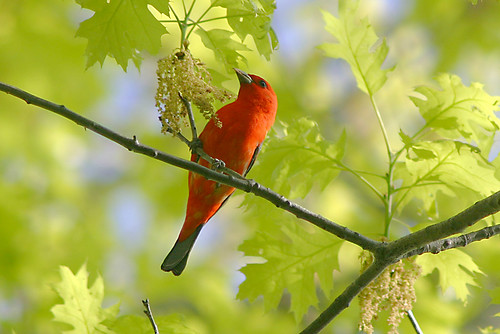
My mouth dropped wide open as a fiery red bird dropped straight out of the canopy and alighted weightlessly upon the lowest branch of the oak. Its jet-black wings brought great contrast to its glowing red body. He leaned forward anxiously, cocking his head back and forth before flying out to the end of the branch for a better look.

Scarlet Tanager_20070503_004

My gaping mouth curled into a grin as I stood there silently in realization that a male Scarlet Tanager had just taken my return call for a challenging male entering his territory. I called back again, and the male flew towards me without leaving the large oak tree. Aching to get a better look, I took a step forward but the dry leaves alerted the male to my presence, and he flew back up into the canopy.

I was elated. I had just seen a bird that I had been searching for since I was a child. I looked back at the large oak over my shoulder as I walked away, grinning in pleasure. Moving on up the trail, I began to look for other large oaks, and scanned the canopy for any bright red bird. Ten minutes later I came upon several mature oak trees, and paused to scan their canopy. My jaw dropped and my face tightened into a grin simultaneously as another male tanager glowed brightly against the bright green oak leaves.

photo by: jayhawk6 - Flickr.com

I watched the bird in awe for a few minutes, and a pale olive colored bird flitted through the oaks around the male. I slowly pulled out my Audubon guide, and flipped to the section about tanagers. The description said something like, widespread and uncommon. Found in the canopies of mature deciduous forest in the eastern U.S. This description was so dry and sterile, yet it was so succinct and correct. If the description had just as plainly instructed me to go walk around a tall forest and look up high in the trees for this bird, I wonder if I would have found them any quicker?

This was the first time I realized that what I had been doing subconsciously for years was actually very important to finding birds, or anything. While I knew where and how to look for common birds such as bluebirds, chickadees, titmice, and woodpeckers, and the patterns of their presence had become very familiar to me, I had never realized that most animals follow very distinct patterns and live in very specific places. After that day, I began to read each description of the birds I had yet to discover for myself very closely. I wasn’t able to memorize things as easily anymore. So, I began to read the book in the woods, and then go searching for individual birds. At this time, I still had yet to find anyone to share this delight with. Perhaps it was just the lingering urge to be alone after the past several years of relative solitude, or perhaps it was just too hard to have such experiences with other people present. Nonetheless I savored these hikes through the woods.

A week later Silas and I packed up and left for our summer in the Adirondacks. It would be several years before I would find myself walking through these woods again, and several more years after that before someone came along to share these experiences with me. Whenever I hear the finch-like screech of a tanager call, everything else seems to fade away, and I can’t resist walking away from whomever I am with to call in these magnificent jewels of the forest.


Monday, March 3, 2008

Familiaris - Finding More Secrets, Looking for Myself

I was feeling a little pressure to get a new post out for people to continue reading, so here it is. It is a continuation of Familiaris. I haven't done enough editing on it yet, so if you care to, please notify me of any mistakes/typos.
---
The closing year of high school brought massive changes to my life. At nineteen years old, I was slowly emerging from a rather tumultuous time in my life shadowed by pointless acts of vandalism and selfishness. Amidst the fading shame on my name and family, I found solace in being alone. For the first time in my life, a book brought me the relief I needed. The distant promise of college provided a means of escape; a place I could start over. My AP English reading list was one of the final important steps for me to take towards college. I still hated reading, and rarely read any book whatsoever. However, college was an unknown. It was a step towards a new challenge, and it scared me to think I may no longer be able to achieve good grades for little input. It would be necessary, so I was told, to begin studying more than ever before, and this meant reading.

So, I scanned the sterile white sheet AP reading list, and wandered through Border’s hoping something would be better than all the inane books we had read in school. Very basically, I believe you can judge a book by its cover. It was the books with the most enigmatic titles with intriguing covers that attracted me. I picked up Catch-22 - a simple clichĂ© that I had heard many times, yet never understood. The cover had a matte finish, with simple white and blue borders, and some scribbled red cartoon of a man in the center. I didn’t know what it was, but it clearly meant something. This book opened the world of creativity to me. It was simply creative, yet gripping - a story based on a defining time in human history, which told a story through detailing the intricacies that bind people together through seemingly banal events.

I started the next book ten minutes after finishing Catch-22. I began reading in most of my classes, hiding my novels inside the textbook for each class as though it were some playboy I was hiding. Come Spring, I had read 56 books, and I felt like a new person. I had taken to wandering the nature section of Border’s, for I found more books there that detailed subjects I already knew well. I stumbled upon books by Tom Brown Jr, and this was the first time I came to understand that people could make a living and publish books based on their experiences in nature, all they need to do is detail them in an attractive way. These books returned me to my childhood, and soon I began to feel the anxious restlessness returning to my legs. I began to writhe in the chairs beneath my ass again. Whereas books had finally brought calm and stillness to my days, I could no longer focus, and the people surrounding me at Border’s began to draw my attention more than the pages before me. So, I began to read alone in my house, but when my family was home, I could not be left alone, and this in turn led me to the final escape that had cradled me so many times in my life – the woods.

Now in the spring of my final year of high school, I began a habit of packing a backpack with books and bread, and headed into the woods around my house after school and on the weekends. I would sit upright against the same oaks I would hunt from in the fall, but still my attention wavered. The stories of Tom Brown Jr. did more than return me to childhood memories; they turned me into a child again. These stories cultivated an excitement to reacquaint me with the secrets that hid in these woods.

With moccasins upon my feet, I would crawl across fallen trees, tracing the scratchy tracks of gray squirrels, following them through the forest, examining the remaining shells of acorns left in their wake. I would hold the shells close to my face until I could see the individual teeth marks where their sharp teeth incised the hard, polished shells. I began to find myself picking up acorns and biting them open. The bitter taste appalled me, and later when I would wash my hands in the sink at home, I understood why squirrels mouths were often so brown - not from the dirt from which they excavated their cache, but from the bitter tannins that stained my fingers brown for days.

I would hop from tree to tree as silently as possible. If I had to step upon the loud forest floor, I learned how to do so without creating an explosion of sound. I began to move quickly through the woods, sometimes unexpectedly coming up behind the animal whose tracks I was following. One time this led me to an abandoned hunting shack in the woods. I vacantly followed the tracks right up to within ten feet of the burrow opening that dove beneath the shack until I was stopped with a shudder at the sound of a loud exclamation. It was something between a horribly loud sneeze and a snarl. I jumped and spun around, looking behind me, then back into the dark burrow opening. I stood frozen as my heart began to pound in my ears. After one more horribly scarey ‘sneeze’ I backed away a few steps, turned, and ran fifty feet before stopping to watch the hole and to compose my pounding heart, but nothing came from the darkness. I walked away confused and scared for the first time ever in the woods. To this day I don’t know what that was.

A few weeks later I went into the woods again to wander and stalk. I went straight up the mountainside following deer trails, and inspected several well-worn buck rubs along the way. Being spring, none of them were fresh, but it was interesting to compare the difference in the bucks’ choices of trees, how heavily they damaged each small tree, and the designs that were left behind from their hormonal frustrations.

I followed the trails up to the ridge, where they dipped down towards a drainage on the wetter, northern side of the ridge. As usual, I passed between the trees my father and I had been hunting in together for years, looking momentarily up into my tree. A hook stuck out from the tree some twenty feet up, where I would hang my bow while awaiting a passing deer.

As the slope flattened out below our hunting spot, the trees grew smaller and the forest grew a bit darker. Two hundred years ago these Pennsylvanian forests were nearly dark as night all day long. Towering hemlocks shaded bright orange clay-bed springs, where brook trout most likely lived long sheltered lives. Now there were gangly saplings of beech and tulip poplar amidst the young hemlock that were slowly succeeding in the wake of the heavy logging of the late 1800’s for which these Bald Hills got their name.

I followed the spring, jumping across from time to time to test my abilities. Bright orange slick spots, worn with hoof prints showed where some deer thought it easier to just walk through the chilling water than to jump. I looked around at the muddy deer paths that riddled this area, and watched the chickadees flit across the white sky from poplar to poplar, inspecting the dry, skeletal tulips for spider eggs.

Once I had followed the drainage far enough, I turned back to the south, and headed back up towards the ridge that would lead me homeward. The forest thickened with poplar and now oak joining in where the soil was slightly drier, but still quite wet. Pushing through thickets of rhododendron, I wiped cobwebs from my hair, and pushed on. Emerging from one thicket I looked up to see a tall and slender bush of rhodo with pale pink trumpet-like flowers. I stopped in confusion, wondering what plant this was, and just then a hummingbird flew up. It was bright orange-red, with darker stripes on its body. I had seen some of these odd hummingbirds only twice before, when I was quite young, and they simply zipped into our yard, inspecting our hanging laundry before disappearing over the trees.

I walked up slowly, but the hummer didn’t seem to notice, or mind at least. As I approached to within a foot of the bush, it shot away to a neighboring bush, and I took the moment to jump into the center of the unoccupied bush in hopes that it would return. I stood motionless as I watched the hummer work through the fragile looking flowers, and all of the sudden it returned to the bush where I was standing. My face contorted into complete confusion as the hummer inches from my face transformed into some type of insect, or was it a moth? I leaned forward to the point where I could feel the air stirred from its wings tickling my nose. The front legs of the reddish creature reached out to the pink flowers as a dark tube unfurled from its head and plumbed the flower’s depth with the softness of an artist’s brush upon canvas. Having spent about two seconds per flower, the creature exhausted its options in less than a minute, and disappeared. While it was there, it stayed still enough at each flower for me to figure out with some assurance that it was apparently some type of moth.

I turned and started running home. I felt as though I had just identified a new species in the woods of Pennsylvania. No one had ever told me of this amazing creature, surely it was because no one had ever seen it. But indeed, this was not so. I first ran up to my room and opened my Audubon nature guide to the east. Leafing through the lesser-known pages where the insects were, there it was, the sphinx moth, but something wasn’t right. This one wasn’t the right color, and the one I saw had a more red body, and compact wings that I couldn’t even see. I turned the page and there was the one I saw - the clear-winged hummingbird moth. I laughed out loud with a smile realizing that, judging by its name, I wasn’t the first to have such a confusing experience with this moth. The moth had a reddish body with clear wings! What an amazing thing, to live and play in these woods for nineteen years, and to still find things I never knew existed.

I leafed through the book, and found the plant that resembled the thick rhodo thickets that covered the lower north facing slopes. It was pinkster, a species of Kalmia, more commonly known as mountain laurel. I had never seen this plant before either. I felt like the woods had showed me some secret most people knew nothing about. I felt it was my secret, and to see pictures of these organisms in this book gave me a wider realization that there were other people out there who must have had these same experiences. This book became a passageway into new feelings of acceptance and inclusion into an unknown group of people. After that, I never went into the woods without that book. Someone had done a lot of work before me, and I was determined to learn it all, and luckily I had to be in the woods to do so.


Monday, February 25, 2008

Revival

The other morning I rode away from my apt. and heard the juncos whispering waves of song into the crisp morning air. I have been noticing male flickers standing atop dead trees again, and they too are beginning their territorial claims in song.

I guessed this is about the time the Cardinals should be singing from the treetops of the maples outside of Smith and 7th St. Cafe back at Bucknell. I was looking through some old LJ entries from three years ago, and the first I heard their calls back then was Feb 7th. Now, out west I have the juncos and the flickers, not that I didn't in Pa though...

Sara and I keep remarking over the smells returning to the air as well. We can smell the warming, wet ground again, and the dew drying from the dead grass.

Fill me with song sweet Spring.

Saturday, February 23, 2008

Familiaris - Cedar Waxwing


I first thought of titling the ensuing series of entries Becoming Familiar, but I often feel many of my titles lack substance and clear embodiment of what I am writing.  As I thought about why Becoming Familiar seemed an appropriate title I tried to trace the origin of these words in my mind, before realizing just how simple this connection was.  

Familiaris, the latin base for several common english words, most directly translates to 'domestic', or so an online etymology dictionary tells me.  Thus, this series of entries details the process of what is now commonly referred to as Developing a Sense of Place, or becoming familiar, familiar with one's domestic surrounding.  I hope you enjoy.  
---
I believe I was about nine or ten when I saw my first cedar waxwing. By then I had taken several birdwatching trips with my Aunt Lucille, to whom I owe a massive debt of gratitude for showing me that there were other people out there who were just as passionately fascinated with the avian lives surrounding us.

At this age, I had memorized the birds in my Roger Tory Peterson’s First Guide to North American Birds, and I had seen most of the birds in this book. The few that I hadn’t seen seemed to accompany my every thought when I was alone and outdoors. The longer I waited to see them, the more majestic they became. A glance of a dark, unrecognizable bird in a treetop far away began eliciting reckless romps through the woods behind my house, most of the time only to find another blue jay hawking through the canopy, searching for nests to terrorize. I had begun to take some interest in reading the quaint descriptions of each species I had yet to see, and slowly I began to memorize these descriptions as I had each picture in the book, but nothing replaces first hand understanding born of intimate observation.

One morning I was standing outside, thrashing a black locust branch across random objects, again laying waste to imaginary foes when I heard a sweeping swoosh above my head accompanied by many nearly inaudible high-pitched staccato chirps. A cloud of nearly twenty dusky birds swept into the gangly black locust tree next to me. I stared up at them, frozen with confusion. I had never seen any flock of birds like this before. One of them swept over to the holly tree ten feet away and froze momentarily enough for me to see a dark crest upon its head. For a moment, its stout beak and crest made me almost see an unfortunately discolored cardinal, but with the flash of a few red feathers protruding from dark wings, the pages of my bird book ruffled past in my mind, leaving me staring at the correct page of my field guide, a flock of Cedar Waxwings…

Motionless, I stared upward, stick hanging loosely in my hand as I watched the flock move busily through the crown of the trees, calling to each other incessantly. I have found few other experiences in my life that bring such a calming stillness to my mind and body as the first time I see a bird new to my eyes.

They flitted from branch to branch, flipping upside down as they seemed to be searching the branches for food. They hurriedly floated from the black locust to a sugar maple, then to the red maple in my front lawn. Keeping my distance, I followed them slowly as though they were my first ‘love’ in fourth grade. Then, only a minute later they let up a chorus and flitted across the road and out of my yard.
-
In the passing years, I only saw a similar flock three more times, each time almost identical as the last. The flock would sweep into my yard, alighting directly into the black locust tree in my yard, and disappear a few minutes later after working through several trees in my yard. It wasn’t until college that I observed a more intimate account of their behavior. If only fourth grade infatuations were so simple…

My senior year at Bucknell I had a wonderful dorm room where I could watch abundant nature. Yellow jackets pollinated the pepper plants I grew on my windowsill. Cats chased rabbits and squirrels from bush to bush. In the fall, I saw several warblers pass through the spruces and small hemlocks on their journey to southern climates. Later, robust chickadees picked spider eggs and papery seeds from the hemlocks in the winter. And in the spring I witnessed a few wonderful events.

One of my favorite springtime treats are maple-icicles. As the trees awaken in the waxing spring sun, branch tips broken off by winter storms bleed sugary sap, which then freezes overnight. As if working to level the playing field among maples, the sharp teeth of gray squirrels bleed trees lucky enough to weather a rough winter unscathed. Climbing out to the ends of each branch, the squirrels nip off the swelling buds, and return hours later to nurse the sweet, calorie-rich exudate.

This action does not go unnoticed however. Across the paved path one morning while I was watching the squirrels suckle their crop of maple syrup, a flock of birds swept into one of the ornamental cherry trees that are so common on college campuses. Their high pitch calls sparked the fuel of reminiscence, and I was a kid again, watching their red and yellow flickering feathers bring my memory aflame.

They acrobatically plucked cherries from the branches nearly the size of their head, and gulped them with careless gluttony. As their crops filled, they teetered on the edges of their branches, while some of them watched lethargically from the ground. I had recently read some of Rachel Carson’s accounts of waxwings drunk and stupid from juniper berries often dying similar deaths as human drunks – either from consumption itself, or from heedless actions resulting in death. I chuckled, wondering how many of them were succumbing to the intoxication of the winter cherry, fermented while hanging on the branch for months past ripeness.

Several minutes later, a few of the less indulgent individuals fluttered across the path to the bleeding maple. They hopped right out to the end of some branches and stretched to the dripping branches overhead. Some would hang upside down for minutes, patiently licking drop after sugary drop.

It didn’t take long for the gray squirrel to return to the tree. Chattering like a mother shooing hungry children from a warm pie, it rushed up the trunk, avidly defending its bounty. The waxwings simply fluttered from branch to branch a little more hurriedly, barely acknowledging the squirrel’s audible distress.

In the short week or two it took for the tree to send the majority of its winter store of sap into fresh green buds and bright, unfurling leaves, I witnessed squirrels, waxwings, chickadees, nuthatches, and blue jays all visiting this single tree outside my dorm room window. Of course, I didn’t stop visiting the trees during the coldest spring mornings to pluck my share of sugary delight from the tree. Rather, in the presence of such kin I celebrated the sweetness all the more, relishing a shared delight in transcendence from the quiet desperation surrounding me.

Friday, February 22, 2008

Familiaris - Indoctrinations of Stillness

I first thought of titling the ensuing series of entries Becoming Familiar, but I often feel many of my titles lack substance and clear embodiment of what I am writing. As I thought about why Becoming Familiar seemed an appropriate title I tried to trace the origin of these words in my mind, before realizing just how simple this connection was.

Familiaris, the latin base for several common english words, most directly translates to 'domestic', or so an online etymology dictionary tells me. Thus, this series of entries details the process of what is now commonly referred to as Developing a Sense of Place, or becoming familiar, familiar with one's domestic surrounding. I hope you enjoy.

---
When I think back to my first memories leading to my love of birds and nature, they show me nuances of my behavior that were with me even at a very young age. I am slowly finding that while many of these behaviors were challenging to my juvenile success, many of them have ironically become important controlling forces in my life.

Even before I was old enough for kindergarten, it was very important to me that I felt included in the highly choreographed early morning rituals of my family. Most mornings I would awaken to the loud, echoing click of a distant light switch followed by the creaking of our basement stairs as my dad went for his morning shower. After glancing out the window momentarily, I would roll over and fall back asleep as twilight washed my room in blue.

The creaking of my dad coming back up the stairs usually stirred me from sleep enough to realize my bladder was sending me painful messages to get up. I tried to place my bare feet on the edges of the cold wooden stairs as quietly and quickly as possible, sometimes leaning on the railing and the wall in order to skip up to four steps at a time. To get to the bottom unnoticed was always the goal, and I’m not sure why. Whether walking through the woods alone, or sneaking up on my sisters or a friend in a house, there has always been a special delight in arriving unnoticed. Perhaps it is just the act of surprising people with my presence that proves pleasing, who knows.
Many mornings, just as I got to the bottom of the stairs, my mom would emerge from my parents’ room for her shower. Eyes barely open she would mumble, “morning,” and make her way to the shower in the basement. My mom emerging from sleep has always been rather comical to me, I guess because it is so opposite from the way I have almost always woken up ready to go. Rounding the dining room and the kitchen, the distinct smell of clean skin and my father’s shaving cream filled the air as I approached the bathroom. I would peek around the edge of the door in attempts not to interrupt him as he slid a razor up the right side of his neck with practiced concentration. The ease with which the plastic wand-razor sheered the stubble from his face was almost impossible to believe.

After that moment in the morning, my dad’s days were primarily unknown to me. On some warm mornings I would walk outside with him to say goodbye as he left for work, then walk around the yard or driveway for a few minutes, but most chilly mornings I would stand on the couch looking out the back window to watch him get in his blue Nissan truck, and quickly pull out of the driveway.

The majority of my mornings, or the whole days for that matter, remain unknown to me as well, lost in time. However, at some point my parents realized my affinity for watching birds, or at least to be outdoors watching animals in general. One day while my dad was home for lunch he introduced me to the ubiquitous animal trap. Wherever I have been that people are attempting to catch an animal without a real trap, it is the box, stick, string, and bait that make up the trap.

My dad set me up with a large cardboard box propped up on one side by a short stick with a string attached to it, me holding the other end of it. A seemingly enticing pile of birdseed sat beneath box, and I was set to catch a bird. After showing me how to wait til the bird was completely under the box to pull the stick, my dad left me to my own devices. I sat as motionless as a four year old can, peering out from behind the edge of our log-cabin playhouse, just waiting for the unwary robins that littered my yard to see the beautiful pile of birdseed, openly inviting their presence. Little did I realize that the primary birds who would like to eat the birdseed, like chickadees and titmice, would never venture so far from a tree to examine this odd pile of food in the middle of my yard, while all the robins littering my lawn had interest in only worms, not seeds. Nonetheless I sat there with determination and belief that given enough patience and stillness, a bird would enter the box, but then I had no clue what I would do. Eat it? Play with it? Just let it go? Luckily it never got that far.

When I tell this story to friends, I have taken to telling them I sat still for six hours straight, but the more I think about this story, the more I realize I have no absolute bearing on how long I sat there waiting with assuredness that I would catch a bird. Time meant nothing to me back then beyond when I got to eat. In my memory I did nothing else between the times I ate lunch with my mom and dad that day, and when my dad returned from work that night around dinnertime.

What I do know looking back on this memory is that time spent sitting still like in the ensuing years and even today are ephemeral and rare. If only school were based on watching living animals and being outside, rather than staring at an inanimate chalkboard and equally stoic teacher, my childhood would have proved much less challenging, and much more fruitful I believe.

Aside from numerous schoolyard fights, and wayward distractions in the classroom, releasing all of my boyish energy on the weekends and after school was one of the only constructive ways I found stillness on my own accord. In exhausted moments between hours spent in the fields behind my house managing the jaggers encroaching upon my demolished sumac thicket, chasing birds and squirrels through my yard, or throwing leopard frogs in the middle of the bass pond in my neighbor’s field, I found wonders that froze this raging boy into someone completely different. In these moments I was so different; someone I suppose many people never new existed. And how should anyone have known who I really was on my own accord when all I was to most people was a bright boy who couldn’t sit still in class, couldn’t keep his hands to himself, and was constantly throwing things or doing anything other than what was expected in those sterile, lifeless confines called classrooms? In this manner my love for birds and nature quietly grew into my being, and remained relatively unnoticed. I was just being a kid, something I thought we all did. Little did I know this lifestyle was quietly disappearing amongst most other quiet and well-mannered kids in my classes.