Why:

Dreams are powerful tools that can help guide anyone to success and happiness. They represent some cherished aspiration, an ultimate ideal of achievement.

The word sylvan refers most directly to a setting associated with the woods. Reflecting on the vigorous life that abounds in sylvan settings is a very powerful force in my life. For me, this word evokes feelings of transcendence, clarity, and unity.

A Sylvan Dream is a dynamic compilation of my life dream. It is an attempt to seek out and document the truth, beauty, and clarity that exists in this world.

Thursday, September 27, 2007

Beneath a Veil

9/27/07
---
It looks too steep. Experimentally I push a slab onto the snow and let it go. It drops away rapidly, picking up speed, and throwing a spray of snow into the air, turns on edge and rolls and bounds like a clumsy wheel all the way to the bottom, shattering on the rocks below.

What I need is a breaking device. An ice axe now would be the thing; I could squat on my heels and glissade sown the snowfield in good form, controlling direction and velocity by dragging the blade in the snow.

I launch a second big stone, and watch it go down with similar results. I see it now, the point is to stay flat. The pitch of the snowfield is less steep at the bottom; it should be possible to slow down or stop before smashing into the rocks at the lower edge.

I choose a third flat rock and drag it into the margin of the snowfield. Facing downhill with my heels braced in the snow, I straddle the rock, grasp and elevate its forward edge with both hands, and sit down firmly (my stick braced under my arm) and sit down firmly, taking a deep breath.

Nothing happens. My feet are still dug in and seem unwilling to obey my command to rise-instinct more powerful than reason. I urge them again; grudgingly they come up.

Too late for arguments now and as usual not enough time for panic. We're sledding down the mountain at a sensational clip, accelerating according to formula. I brake my speed with my boot heels as best I can but I can't see a thing because of the gush of snow flying in my face. Halfway down I lose the slab I'm riding and go on for a piece without it. The rock follows hard upon me, almost at my neck. I manage to recapture it and climb partway back on but before I can get comfortable again I see an outcrop of immovable granite, which I hadn't noticed before, rising in our path. I abandon the slab, roll to the side, and go skidding past the obstacle by an adequate margin. Things are out of control at this point but fortunately the snowfield begins to level off. I get my boots in front of my body, dig in, and coast to a stop a few feet short of the broken rocks at the bottom of the couloir. As I sit there resting another loose object thunders by on my left, perhaps the same rock or part of it that I had started down with. A moment later comes my walking stick.
---

This is a passage from Desert Solitaire, by Edward Abbey. He wrote this during his several summers spent working for the forest service in Moab. If you like this, read the book, enough said.

This passage reminds me of a mixture of many of my experiences in the woods the past several years.
It reminds me of when Silas and I were working on trail crew in the Adirondacks together. Building staircases out of boulders we would quarry out of the ground with 20lb rock bars, we would roll and hump these rocks across the ground, up slopes, and haphazardly down the other side, until sweating and encrusted with the marrow of things, we would be ready to dig a hole to cradle this behemoth, or if we were lucky a co-worker friend would have it semi-ready for us to finish.

I remember one perfect quarry site where many of our chuckling guffaws echoed through the forest and across the lake at the bottom of the hill. Peaked Pond. Amidst a cracking outcrop of boulders were rocks the size of small Hondas. Some of these rocks found their way over to the trail to a new resting place, while others which we deemed too large to work with were sent careening over the ten or twelve foot cliff, a few hundred feet through the forest where they smacked into the trunks of towering birches, maples, oaks, some two feet wide, leaving gaping wounds on some while others were simply sheered off by the largest boulders.

Our crew leader spent hours placing the rocks we quarried while she left us to our own devices a hundred yards away through the forest. I suppose she would pause between grunting movements with the rock, and at hearing our shouts of laughter as another boulder crashed through the woods she would smile with satisfaction. As destructive as it was, we felt as innocent as kids again. As wrong as it was, those trees grow back, and those memories continually draw me back into the canopy of a mountain forest.

Friday, August 31, 2007

Sunrises, Reflections from Camp

Mornings not began with the sunrise seem hollow and lost to me. It feels as if the world has moved on without me, leaving me looking on, left in the empty dreams of my sleep. In the quiet beauty of each sunrise, I join a congregation with all existence that is warmed by the sun, and in this light I know all that I belong to.
---

Lying on my back in a circle of campers, I stare up into the early morning sky, examining some cirrus feathers many miles above, floating imperceptivity across the sky. Keeping a rather constant form, they float like ice crystals through the heavens.
As I observe the depth of this smooth cerulean sky, I notice the subtlest lattice of cirrus, lacing almost invisibly across the sky. In periods measuring tens of minutes they dissolve and reappear - ghosts haunting some ethereal reaches of this world. Whispering of pale blues, the sky fades to a pale white just over the Divide to the west.
As a scarlet sunrise builds on the Divide a family of coyotes let up a chorus of archaic chattering howls. While no one in the circle appears to awake, almost everyone stirs, rolling over, unaware of the subconscious stirring of their mind in response to such a sound. Some simply shake their feet back and forth several times before sleep returns them to stillness. These howls resonate across the land signaling meanings I can only imagine. Perhaps they have killed one of the elk calves that reside in the lower marshy meadows, or perhaps they simple sing the coming of a new day, full of whatever promise and vigor a new day brings to a coyote.
I wonder how such sounds strike the rest of the wildlife around the lake as the familiar uneasy emotions well up inside me at hearing such macabre calls. The veracity I hear in those howls haunt me. Those howls seem to sing out a warning song, celebrating the penetrating sting of their teeth.
As the song falls to one last singularly bold apex, Buteo, an amazing young camper, stirs and notices I am no longer next to him. He rolls around and eventually finds where I am sitting at the picnic table listening. We exchange a knowing smile, and he quickly rolls back over to sleep, not wasting time to revel in any sense of sentimentality of the moment. In one glance he was able to communicate to me that he too felt coyotes song resonate within him.
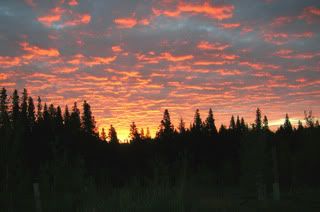
A scarlet hue sweeps across the highpoints of the land as the sun peeks over the flat horizon to the east. Audubon, several miles away, blushes in the warm embrace of the rising sun. The scarlet curtain sweeps down from atop the hills, across the meadow, highlighting the aspen groves. The hill above the lake fades from a pale gray twilight to a hazy wildfire glow. Every morning I sit attentively, telling myself that if I observe acutely, I will notice this curtain sweep across the marshy alder thickets, over to the slope where I sit in earnest, and I will be draped in the sunrise. Nonetheless, just as I feel the warmth of the direct sunlight upon my feet, the scarlet curtain sunrise dissolves into a lemon-yellow haze and thus, the day has now begun.
Bright sunshine dapples the top of the trees throughout camp, and soon soft morning exhalations whisper through the trees, softly jostling them awake. The top of a Ponderosa shutters with a calm shiver and dampens back to rest like a sleeping dog shifting restlessly in the corner of a room.
Red-Naped Sapsuckers signal back and forth in the calm after sunrise, tapping out a stuttering irregular pattern on a hardened aspen or perhaps a coffee tin left nailed upon a tree on the edge of the meadow for who knows what reason. I hear their young fledglings yelp a whiney call several times back to the parents and then move on to check their crop of bug traps in the ponderosa and lodgepole stands adjoining the meadow. The sticky sap that exudes from the lateral line of holes they excavate effervesces a sweet vanilla-butterscotch smell, not only sweet to humans apparently. Sapsuckers obtain almost the entirety of their nutrition from the attractiveness of this sap to all of the insects that are lured unknowingly to its stickiness. With the sunrise complete, the campers began to stir awake. I put a pot of water on the spider stove, and prepare to cook breakfast.

Tuesday, August 28, 2007

We All Have Interesting Histories

Aconitum columbianum, commonly known as Monkshood, is a rather intriguing plant to me.

Monkshood is a member of the Buttercup family, Ranunculacea in Latin. This is interesting because rana means frog. This plant is essentially in the frog-foot family because it likes to live in wet soils close to constant water. Most buttercup species are named so in English due to their bright yellow buttery flowers. However, Monkshood, along with its close relative, Larkspur has somehow developed purple flowers with completely different flower morphology. Rather than the common open-faced flower form, this flower has developed a much more challenging gambit for their pollinators to navigate. Two thin sepals hang like legs from below the hood, allowing a landing strip of sorts for the small bumblebee to land. The small bee then quickly crawls up into the narrow chamber of the flower brushing its undersides over a bed of anthers full of pollen. Once the bee reaches the narrowing top of the flower it stretches its tube-like proboscis about half the length of its body to the top of the flower where it receives a drop of nectar from each flower. I remember the first time I sat long enough to observe a bee visit one patch of flowers, meticulously flying from plant to plant for over twenty minutes.

What amazes me about pollination is not only how important the form of the flower to the bee is, but the intricate yet chaotic timing of maturity that occurs when the flowers can give off pollen, and when they can receive pollen. If the female part of the flower, the stigma, were receptive at the same time the plant was giving off pollen, it would simply reproduce with itself. Not good. To inhibit this, the stigma will usually become receptive before the pollen is being released, or after all of the pollen has been dispersed. So, the natural chaotic pattern that the bee creates, flying from flower to flower, patch to patch, day after day collecting its food, along with the timing of the flower's reproductive organs creates the perfect pattern through which to carry out all of the reproduction of the flowers it visits while ensuring maximum dispersal of each flower's genes.
This ingenuous symbiosis is what allows plants to spread their genes all over the earth, all the while using the motor skills and desire of other animals, especially humans. Michael Pollan has written a whole book, The Botany of Desire, about this phenomenon regarding how humans have selectively spread the genes of the most sought after plants all over the world via nothing more than our desire for sweets, drugs, and nutrition.

The Latin name, Aconitum, comes from the word for monk, or aconite. I find not only this name, but the shape of this flower intriguing since monks were often the individuals most in contact with this flower, since they held the majority of medical knowledge in ancient European culture. The potent alkaloid, aconitine, is found throughout the whole plant and affects the ability of the muscles in the heart to pump correctly, effectively stopping the heart in even small doses. Despite this, Monkshood was commonly used to treat people with heart problems, for it was thought to ameliorate symptoms of arrhythmia. This plant was also stuffed into sheep meat, and then set around the fences of sheep pastures to kill off harmful wolves. Criminals were also executed with distillates of Monkshood. Some Harry Potter enthusiasts may recall a Wolfsbane potion used to repel werewolves or something in the earlier books, which called for monkshood flowers.

In the late summer months monkshood and goldenrod blooms form thick glowing patches of deep purple and yellow along verdant sections of the trail in the western United States. During a backpacking trip this summer in the Indian Peaks Wilderness Area in the Rocky Mountains, I came upon a very tall patch of albino monkshood under the shade of Aspen and Coltsfoot while wandering around off of trail looking for a good place to dig a cathole. The whole plant was completely identical to regular Monkshood, yet the whorl of flowers atop each plant was completely white with vaguely green veins. This albinism is a rather rare occurrence, but is known to occur from time to time where the flower is abundant.

Saturday, August 25, 2007

Beginnings

In accord with this new lifestyle in Boulder, this blog will be an attempt to refine my thoughts, conversations, and photos in my mind as well as with others; a new continuation of My Sylvan Dream.

The post-college lifestyle has been nothing short of a roller coaster ride, and hopefully this forum will push me to focus on the clarity I know exists out there that is waiting to be expressed.