Why:

Dreams are powerful tools that can help guide anyone to success and happiness. They represent some cherished aspiration, an ultimate ideal of achievement.

The word sylvan refers most directly to a setting associated with the woods. Reflecting on the vigorous life that abounds in sylvan settings is a very powerful force in my life. For me, this word evokes feelings of transcendence, clarity, and unity.

A Sylvan Dream is a dynamic compilation of my life dream. It is an attempt to seek out and document the truth, beauty, and clarity that exists in this world.

Monday, April 14, 2008

Springtime at Home

Pennsylvania is exuberant in April. Walking around outside these days fills me with excitement and content simultaneously. Pennsylvania welcomes me with a warm and pleasantly humid embrace, and whispers the purest of songs into my ear, telling me to rest, for I am home.
Spring begins its song unhurriedly as winter becomes tired. I heard it this year in Boulder, with the junco’s first trill into the crisp early morning air. The flicker was not long behind the junco. The first one I heard this year stood atop a torn cottonwood along 28th st. in Boulder, spewing its staccato cry as I drove by after a good climbing session. I have come to dislike this call so much after encountering several vociferous individuals. Their loud call echoes over treetops and deafens those unlucky enough to find one tangled in their mist-net.
Driving back into Pennsylvania as the sun was setting, the folded hills, (or mountains as we call them here) began to glow in the waning light. Maple buds shown a scarlet red, and now today they have begun bursting forth with a bright lime green flower. Then a sweeping column of light caught my eye as a four-wheeler spun around the corner of a distant field and barreled down the steep hillside, reminding me I was coming home to a different side of spring as well.

As I pulled up to a past professor’s newly acquired land, the sound of spring enveloped my attention. I stepped out of my vehicle and slammed the door quickly to notify my host I was there, but also to regain silence as quickly as possible to hear the sounds surrounding me. Off in some pencil-necked red pines, a brown tree creeper swung his song around the trees as jubilantly as he circles them in a female’s presence. Then the frogs and toads fell on my ears. Such a beautiful and disarming sound I have yet to find anywhere else. For years I laid with my head hanging out my bedroom window at night until I fell asleep to the sounds of these peepers. The wood frogs had already come and gone, leaving heaps of milky-white eggs in the vernal pools endowed to this rich land, but I still think I heard a few croaking reclusively like an old floorboard in a smoky cabin. After only momentary rests, the peepers reclaim the spring air with a trill I will not even try to describe. I simply implore you to come to the Pennsylvania woods when the earth is waking up to hear such a welcoming sound.
It was the sound of the spring peepers in the pond down behind my house that brought dreams of the lightning bugs yet to come during my childhood. As post-mating pleasure deflated the peepers’ vigor, unable to sleep in such quietude I began to gaze into the warmer evenings with my windows open. After many nights blanketed in black with occasional silvery moonlight, I would finally see them. Arriving like heralded ghosts, I would squint into the night; never completely sure of my eyes for some time. The earliest intrepids would flicker their butts perhaps only once or twice every five minutes as they climbed the branches of my neighbors apple trees, but as they dropped from the treetops and lifted into flight I was made sure of their presence, as they flickered off into the fields around my house to find others. These early fireflies had a tough time, much tougher than those to arrive a few weeks later to a veritable orgy filling the field behind my house with such an ethereal dance the heavens must become jealous.

Sloshing through the marshy creeks braiding through the land, C.C. showed me around to the pools and ponds as we shared enjoyment of the season’s magnificence. We stopped from time to time, glassing the pond in attempts to identify a sheepish fox sparrow or swamp sparrow flitting around the grass and tree branches. Sparrows still seem hopeless to me, but C.C.’s interest in them reminded me that while my true interests will never lead me astray, my love for Natural History should remain broad and encompassing.
Twenty minutes down the road at Bucknell, similar songs welcomed me. I took a walk with another friend, laying on the ground from time to time to get a closer look at some of the first spring flowers that polka-dot the lesser-known wilder lawns of the University. It is so sweet to be home in the welcoming arms of my spring birthday in Pennsylvania, full of April vigor.


Thursday, March 27, 2008

Lake Crescent, Washington - Teaching at Olympic Park Institute

Here are some photos from the past week to check out. I will be uploading more in the coming week, and I will try to write as I have time. I am currently on the Olympic Peninsula, teaching Forest Ecology and Natural History at the Olympic Park Institute.

The sound of the students' paddles pounding on the gunnels of the 20 person canoe boomed across the lake as the early morning sun shed warmth on the snow covered trees surrounding Lake Crescent. We stopped from time to time, and the kids looked around at the surrounding mountains, and down below into the shimmering emerald waters. Many of them remarked at Mt. Storm King, a mountain they had climbed the day before; a first for many of them, and something they all claimed to be very special to them.
---

---
Marymere falls tumbles some 180 feet, spraying mist on us as we approach and lean over the wet cedar railings. A swift breeze chills my face and neck as I pull out my camera to take a picture of these murmuring falls.
---

---
Kids ran around screaming as they threw muddy snowballs at each other after breakfast. Fat snowflakes fell on my cheeks and hair, casting dimples across my face and across the lake.
---


Thursday, March 20, 2008

Beginning of Lasts, for awhile....

This morning, I got up at sunrise to watch the sunlight glint upon The Divide one last time, at least for awhile...


Later, I stepped out into the relentless Estes wind and walked past the first place Sara lived during her first Winter in Estes Park. I imagined I could look through the walls as I walked past, able to see shadows of our memories, laying in each other's arms while the Winter wind wailed on our warm cabin.

The early Spring provided a pleasant distraction as I walked down the road towards Kind Coffee. Pygmy nuthatches sailed in the wind, sallying between trees, sometimes carrying a fat larvae in their beak to a hidden crevice in a dead tree. A magpie dove and bobbed up behind a much smaller chickadee, chasing it for awhile before veering off in its original direction toward the Big Thompson river. The way the magpie dashed at the chickadee with a seemingly relentless vigor, and listlessly turned direction a second later reminded me of Farley Mowat's descriptions of arctic wolves darting at caribou herds maliciously, only to run through the herd, giving no serious chase to any individual. I guess the magpie was just checking for the chickadee's health, in case an easy meal should be awaiting...

I watched a red-tail circle over a field continuously. Its bright rusty tail danced in the wind, keeping the hawk moving slowly across the field in the strong wind. Chickadees, nuthatches, juncos, and finches all fell quiet below the hawk, sticking to the thicker parts of the ponderosa until the dark shadow above passed.

Goodbye Estes Park, Continental Divide, birds, and all the memories, at least for awhile...


Monday, March 17, 2008

Hungry at Home - One Idea for Change

For all I know this idea has already been cast out there to make a change in our homes, but here is something I have been finding myself doing for several years, and I thought it might help if more people started doing. So, I did some reasearch, and some math, and here is what I have come up with.

In October of 2006, the population of America (USA) broke a landmark, 300 million. Today, we are at 304,063,731.

Roughly 3.5 million, or 1% of our nation's population are homeless, in that they spent a significant period of their life sleeping in automobiles, cardboard boxes, tents, caves or railcars. Roughly the same number of our population are considered malnourished with inadequate housing. Approximately 12% of our population is malnourished even with adequate housing.

This means that if just 75 million people in our country (that's 25%) pick one meal a week to buy a meal for a homeless person or someone in need, our country's level of malnourishment within homeless populations could be nearly eradicated.

This is by no means a cure for a nationwide problem. But now a-days I find most people (myself included) feel disassociated with the ability make a large change in the world. This is one way that collectively, we could make a huge change in the world, by buying one meal a week for someone in need.
---
Last week I asked someone I commonly see in Boulder, (known as the High Plains Traveller) if I could buy him anything that would help, perhaps a meal, or a warm drink, and he said all he could use was a Hot Chocolate at the moment. So, I walked up to the local cafe, and I bought him a large hot Chocolate with whip cream.  After I gave it back to him, we talked about some of the incense he was burning for a few minutes, and then I went my way.

Today, I passed someone else on an offramp, an older lady, with a sign for help. I decided I had some money to spare again, so I dropped my car off to get brakes, and walked over to the nearest Whole Foods. I bought a whole Rotisserie chicken for $10, and a two month supply of multivitamins for women for $10, for a total of $20.

I walked the 10 minutes over to her on the offramp, handed it to her, saying "I hope this helps."

She said thanks twice, and smiled widely when I told her it was a chicken. Then I turned and walked away, not knowing what else to say. I never know what to think other than if I was that lady, I think that would help me, but I always find myself wondering if I am really helping these people.  I must be helping these people, because I know for a fact that if 74.99 million people every week took it up on themselves to buy someone in need a meal, no one would be malnourished.

I always want to sit and talk to these people, for I would love to speak to someone. Being homeless and malnourished must be lonely at times. However, only a few times have I been able to successfully sit down and have a conversation in this circumstance. It seems that most times the difference in our worlds are so great, it is difficult to even speak to each other, as if we were of different language or culture.

Anyways, I have decided that this is going to be something I am personally pledging to myself to do every week. I hope you will join me in this pledge to help others for no other reason than if you were in such a situation, you would hope others kindness would keep you alive. Please turn your kindness into something powerful to keep someone alive, and please share this idea or post with other people.

Tuesday, March 11, 2008

Morning Walk Part Two- Geology supports our Ecology

As I finished up my last post, I mentioned how my time living around the foothills has been quite the study of microclimates. There are such sudden changes in this land, and such sudden changes in the vegetation. What first strikes me as a bleak landscape, always diverts my attention to what signs of ecology are present, and it always seems to start with the geology.

Some 70-40 million years ago Colorado, and much of today's U.S. was a vast inland ocean, covering the majority of the country. But a hotspot was forming beneath the earth's crust as a continental plate to the south of North America subducted and melted, creating great pressure just beneath the surface of this ocean. What has become known as the Laramide Orogeny (meaning uplifting) was essentially no more than a massive blister on the surface of the earth, that erupted. Massive volcanoes rose out of the ocean as the sea level fell away from the whole continent. These volcanoes have since eroded, leaving only their granitic roots exposed within the heart of the Rockies. Over millions of years, the seabed turned to a hard crust beneath the weight of ocean. This plastic crust bent upwards as this volcanic blister rose from the depths of the earth. Over many years, these sandstone rocks were heated to high enough temperature for long enough times to change their composition, or metamorphose them the same way we heat sand up to change it into glass.

The foothills and flatirons are the relics of these ancient seabeds that were bent up into the sky as the rockies rose up from beneath them. This creates little ridges all over the foothills where one side (the southern side) gets bathed in sun all day long, while the other side (the northern side) receives almost no direct sunlight. As lichens grow communities on these bare rocks and invite other organisms to the new community, soils begin to form in the crevices of the aging rocks, and over time the soil gets deep enough to support fields and even forests. This is where the amazing things happens.

The term microclimate refers to, a specific climate that exists within a specific area. So, while the general temperature along the front range today is currently 55 degrees F, the northern shaded side of these ridges may be 40 or 45 degrees F, while the sunny southern side may be close to 70 degrees F. This creates massive differences when you take seasonal weather extremes into consideration.


So, in this photo above, you can see where the northern side of the slope to the right still maintains snowcover from over a week ago, while the sunny southern side to the left of the photo is completely void of snow. This speed at which this snow melts on either side of the slope creates huge temperature and relative humidity differences on a daily basis, and the vegetation bears witness to this. The left side of the photo shows rocks, ponderosa pines, and short grass and succulent species, while the right side of the photo clearly shows higher density of ponderosa pine, and taller scrub oak and other shrubby species. It is amazing to sit around and witness the ways the animals that live in these foothills have adapted to these diverse microclimates. We are still slowly learning their adaptations. Take deer for one example.

Deer sleep in the cover of the higher shrubs, and graze on the vegetation of the drier areas during the day. That is all cool, but what blows me away is how they affect the landscape.

Most people are aware of the ancient Inca populations that lived high in the mountains, and terraced their lands so that they could still perform agriculture without rain eroding their bare slopes during tilling and planting times. Do you think they learned this through an epiphany one day? NO! Alpaca and other llama like species graze these alpine hillsides, and over generations, their trails form mini-terraces, perhaps 3-6 inches wide. Our deer to the same exact thing. Year after year, they form trails that run parallel to their older trails. This minimizes the impact over any one area, and at the same time also improves the ability of the land to stand up to severe weather! Below is a photo I tried to manipulate to show these terraces on the hill. The youngest trails reflect light the best. I haven't gotten a really good picture of this yet, but if you see the whitish lines in the middle of the photo that go up and down, these are the terrace-like trails formed by the deer of the foothills.


I know this photo isn't the best yet, but how amazing is that?!

Morning Walk Part One- Colorado Foothills

After a wonderful conversation with someone in the UK this morning, I went for a walk in the foothills. I began walking from the parking lot along a gravel path. Random runners and mothers running with strollers passed me every few minutes, looking at me as though it was odd I was walking.

There was barely a cloud in the sky. Far to the north, faint hues of cirrus whispered across the sky. A cold wind blew between the gaps in the foothills. I began to mentally prepare myself for a cold hike, but looked up ahead hopefully at a small ridge that I hoped that sheltered from the wind.

A few minutes later I cut off from the gravel trail and began making my way across the field. Meadow Larks dropped their songs into the air like cold water trickling over rocks Their nebulous voices always leave me completely unsure of where they are. Sometimes I feel sure they are only 25 feet away, only to find out they are over 200 feet away. They almost always are perched atop some yucca flower stalk or scrub oak branch. Not only do their feathers camouflage them very well, they also reflect light with the same intensity as the dry prairie grass, making them blend regardless of what angle you may be searching from.


The field slowly began to bend upwards into a ravine. As I scanned the hills for deer and birds, something white caught my eye. It was the remains of a deer. Teeth marks riddled the remains of the spinal column where raccoons and mice gnawed on the bones through the night to get much needed calcium. I have found deer bones almost every time I have gone hiking in the foothills.


Some birds caught my eye up the hill atop some rocks. A brilliant blue flash let me know mountain bluebirds were about. I stalked up to them, my presence quite obvious, just attempting not to scare them away. I managed to snap a few photos before they flew down over the ravine to the next rise in the land. The longer I watched, more of them alighted from around me, 18 in all, male and dusky female alike.


I waited for a few minutes, hoping they would return to the prominent rock I flushed them from, but they didn't. I continued up the ravine, and it flattened out momentarily before sloping up into a deeper ravine. My time living around the foothills has been quite the study of microclimates. There are such sudden changes in this land, and such sudden changes in the vegetation. What first strikes me as a bleak landscape, always diverts my attention to what signs of ecology are present, and it always seems to start with the geology, but I'll save that for the next entry.

Wednesday, March 5, 2008

Familiaris - Scarlet Tanager


One winter when I was perhaps twelve, Silas and I were walking down the snow-covered road towards another friend’s house, sleds in tow. Fresh snow blanketed the Pennsylvania woods, insulating a calm stillness. Our boots thudded with each step, and skidded over the gravel beneath the snow. Despite this calm, the sudden quiet made us look up from our feet periodically as though we were being watched. We were the only things moving it seemed; the only things not covered in snow. I scanned the barren canopy above us, squinting into the bright white void above. Usually a flock of titmice or chickadees could be seen flitting through the tops of the tall tulip poplars and oaks in the forest surrounding us, but even these individuals appeared to yield their daily duties to the sudden change of weather.

Finally, off in the distance a bright scarlet flash exploded from the white stillness. I remember yelling something to Silas, and took off after the aberration. I knew it. Deep down, I felt it was the bird; one of the few remaining left in my bird book to check off. Running up the road, my boots thudding only slightly louder than my heart, I stared into the trees. I needed only one more glimpse to be sure.

“It’s a scarlet tanager,” I exclaimed to Silas, “I know it! That’s the first I have ever seen!” Saying its name helped me feel convinced of its presence, as though its name could draw it from the woods. However, after one intrepid outburst, only the calm quiet remained.

Later I showed everyone the drawing of the only bird I know that is brighter red than the eastern cardinal. Even in this drawing, its bright red body seemed to glow, and over the years I had repeatedly daydreamed of seeing one dart through the forest. However, despite all of this excitement, I felt a doubt in the pit of my stomach that I was wrong, but I couldn’t deny myself the pleasure of such a sighting. So, I told only the people I felt wouldn’t even know what a tanager was in the first place so I could relish in the pleasure of denial.

It wasn’t until years later that I would come to acknowledge the fact that I was definitely mistaken in my excitement, and that there was no possible way I had seen a scarlet tanager in Pennsylvania, in the dead of winter. Most of them were thousands of miles to the South, waiting out the northern winter in the tropical latitudes of the Andean mountains.

---

Having completed my first two semesters of college with desperate success, I returned home for a week before heading North to the Adirondacks with Silas. We were about to begin another adventure together working on a trail crew in the muddy, black fly infested High Peaks Wilderness Area. One year of college had brought much change and distance to our previous lives, and deep down I think we were both tormented over the possibility that our childhood, or even our dear friendship, was fading.

Similarly, I had never spent so much time away from my home. Being away from home was never really an issue in my life, but being gone for so long subtly changed the way I felt up on returning nonetheless. For the last nine months my home had become hours reading in 7th st café, a lecture room of sleepy faces, and a wonderfully large single dorm room. Yet as I walked around the flowerbeds in my yard and looked up the hill into the verdant forests, an underlying tone girded a marginal sense of comfort that was relaxing all the same.

While my family was off to work, I enjoyed several days void of responsibility. The soil was warm and wet, and as I walked around the lush grass inspecting hundreds of brown mushrooms, mud squeezed in between my toes. The bright morning sun brought hazy heat to the day quickly, but luckily there was relief to this day. In the afternoon, a warm breeze swept in over the western ridge, sending undulating murmurs through the forest.

With no pressing engagements, I slipped on my moccasins and wandered across the road, past the apple trees in Mrs. Hollerbush’s old overgrown farm, and finally up into the edge of the oak forest. My feet slipped on acorns and soft soil as I followed the same deer trails as always into the forest. Things atop the ridge however, were quite different. My father had told me how the loggers’ promises had finally sunken in the ears of local landowners looking for money, and finally the forest I knew growing up became a memory. As I topped out on the ridge, the forest opened up and was hot. All of the large poplars and oaks were gone, as well as many of the maples. With reserved dismay, I surveyed the new forest. Large patches where laurel and rhododendron had blanketed the understory were now replaced by tangles of choking jaggers. I felt embarrassed as I looked up to the remaining trees. They looked awkward and sheepish, like the first day of middle school when every year several unlucky boys realize that over the summer they suddenly became several inches taller and much skinnier than everyone else.

Luckily that moment didn’t last long. A flicker in the bushes caught my eye, and an odd rusty colored sparrow-like bird flitted through tangles. A small flock of titmice ensued, and then there was a cardinal. I followed them, trying to get a better look at the unknown bird for a minute before they flitted off out of sight. There was still life here indeed, and animals I didn’t know. As I walked across a fallen poplar left behind by the loggers, I thought about how I had never seen those birds at this place before. This change in forest and the new food and shelter the jaggers brought had also brought different birds to this spot in the forest. Later the next year in college, I would learn what edge habitat and forest succession was, but right now I was still slightly dismayed over the change in my home forests. I crossed the deep scar of the jeep trail, and continued down past our hunting trees almost completely atop fallen refuse logs. At this point in the forest, the soil drops away leaving a sea of small, moss covered boulders amidst smaller trees. I hopped along atop the boulders, feeling their rough edges through my moccasins as I followed the slope down until it flattened out in the valley floor. I followed the spring that emerged here as I had done many times, and then cut back up into the forest where the laurel was thick.

As I got to the pinkster bush I had seen the hummingbird moth at the previous year, I paused to look around. The pale pink blossoms were fading, most of them having shriveled past prime. Realizing there were most likely no sightings to be had, my attention turned to the canopy. I followed some chickadees floating from tree to tree, and my eyes fell upon a large oak farther off through the forest, where I saw two larger birds in the shadows up high. As I worked my way over to the tree, a loud bird song came from up high in the oak. It was playful and screechy, similar to a finch in the morning. I called back absent mindedly, attempting to mimic the call, looking up into the oak as I finished.

My mouth dropped wide open as a fiery red bird dropped straight out of the canopy and alighted weightlessly upon the lowest branch of the oak. Its jet-black wings brought great contrast to its glowing red body. He leaned forward anxiously, cocking his head back and forth before flying out to the end of the branch for a better look.
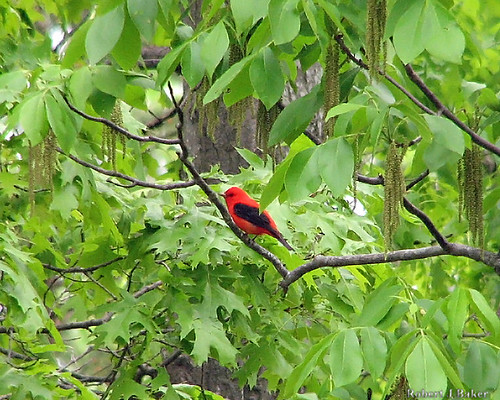
Scarlet Tanager_20070503_004

My gaping mouth curled into a grin as I stood there silently in realization that a male Scarlet Tanager had just taken my return call for a challenging male entering his territory. I called back again, and the male flew towards me without leaving the large oak tree. Aching to get a better look, I took a step forward but the dry leaves alerted the male to my presence, and he flew back up into the canopy.

I was elated. I had just seen a bird that I had been searching for since I was a child. I looked back at the large oak over my shoulder as I walked away, grinning in pleasure. Moving on up the trail, I began to look for other large oaks, and scanned the canopy for any bright red bird. Ten minutes later I came upon several mature oak trees, and paused to scan their canopy. My jaw dropped and my face tightened into a grin simultaneously as another male tanager glowed brightly against the bright green oak leaves.
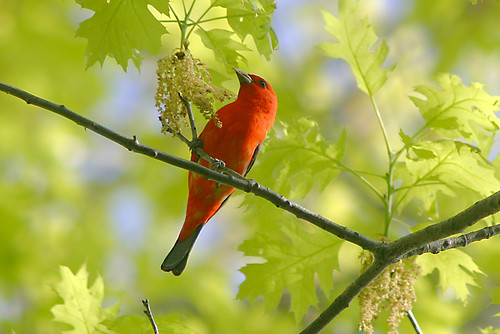
photo by: jayhawk6 - Flickr.com

I watched the bird in awe for a few minutes, and a pale olive colored bird flitted through the oaks around the male. I slowly pulled out my Audubon guide, and flipped to the section about tanagers. The description said something like, widespread and uncommon. Found in the canopies of mature deciduous forest in the eastern U.S. This description was so dry and sterile, yet it was so succinct and correct. If the description had just as plainly instructed me to go walk around a tall forest and look up high in the trees for this bird, I wonder if I would have found them any quicker?

This was the first time I realized that what I had been doing subconsciously for years was actually very important to finding birds, or anything. While I knew where and how to look for common birds such as bluebirds, chickadees, titmice, and woodpeckers, and the patterns of their presence had become very familiar to me, I had never realized that most animals follow very distinct patterns and live in very specific places. After that day, I began to read each description of the birds I had yet to discover for myself very closely. I wasn’t able to memorize things as easily anymore. So, I began to read the book in the woods, and then go searching for individual birds. At this time, I still had yet to find anyone to share this delight with. Perhaps it was just the lingering urge to be alone after the past several years of relative solitude, or perhaps it was just too hard to have such experiences with other people present. Nonetheless I savored these hikes through the woods.

A week later Silas and I packed up and left for our summer in the Adirondacks. It would be several years before I would find myself walking through these woods again, and several more years after that before someone came along to share these experiences with me. Whenever I hear the finch-like screech of a tanager call, everything else seems to fade away, and I can’t resist walking away from whomever I am with to call in these magnificent jewels of the forest.